

Skip to content
Navigation

702-871-8678

News

Connecticut LLC and INC Annual Filing Requirements

Date: 01/19/2026 | Category: | Author: developers

Connecticut LLC and INC Annual Filing Requirements

Connecticut is fast becoming a great place to start a new business. It is emerging as a vibrant new-age hub for startups, with a technology-driven business ecosystem that nurtures entrepreneurship and innovation. The two most favored structures for entrepreneurs in this state are a limited liability company and a corporation. Whatever business entity structure you choose, you must comply with state laws. This includes Connecticut LLC annual requirements and those of any other structure. Annual requirements are important and may have separate processes based on entity structure. Hence, we have created this guide. It aimed to provide you with insight into the different annual filing requirements in the state. The guide will provide an overview of the Corporation and LLC annual filing in Connecticut.

Connecticut LLC Annual Filing Requirements

Connecticut LLC annual requirements are governed by the state’s business laws. The primary requirements are mentioned in the 2024 Connecticut General Statutes, Title 34 – Limited Partnerships, Partnerships, Professional Associations, Limited Liability Companies and Statutory Trusts, Chapter 613a – Uniform Limited Liability Company Act. The requirements for LLC annual filing in Connecticut may differ from those for other entities, such as partnerships, sole proprietorships, and Corporations. If you start a limited liability company in this state, then the important annual requirements are categorized as follows.

Connecticut LLC Annual Report

The annual report is an important document that is mandatory in most states in the USA. This report should not be mistaken for the financial statement that is released by small businesses or large enterprises at the end of a financial year. The Connecticut annual report refers to a type of document that contains basic information related to your company, like the names and addresses of your registered agent, as well as members or managers.

What does it include, and how to file it?

A domestic as well as a foreign limited liability company is required to file a Connecticut LLC annual report pursuant to CT Gen Stat § 34-247k. (2024). It will contain specific business information like the name of your company, mailing address, street address, name and address of the registered agent, and a valid electronic mail address for communication with the Secretary of the State. The information contained may vary from one state to another. A Connecticut annual report also requires you to provide the North American Industry Classification System Code (NAICS). This is a standard that is used by Federal statistical agencies for classifying all forms of business establishments. The annual report has to be filed online with the Secretary of State – Business Services Division, along with a filing fee of $80. Hence, you will need to first create an account with Business CT GOV.

What is the due date for filing?

If you have formed a limited liability company, then the first Connecticut annual report has to be filed with the Secretary of the State after January 01st and before April 01st of the year that follows the calendar year in which your LLC was registered. Subsequent annual reports have to be filed during the same time each calendar year. Let’s look at an example to understand this.

Example: If you have registered your LLC on July 18, 2025, then your annual report will be due after January 01, 2026. You will need to file a Connecticut LLC annual report prior to April 01, 2026, to avoid any penalties.

Penalties if you fail to file

It is always recommended to be compliant with the dates of LLC annual filing in Connecticut, but there are times when you may miss the due date. If your annual report is overdue or you are unable to file your annual report, then the office of the Secretary of the State may dissolve your company pursuant to CT General Statute sections 33-890 and 34-267g.

Connecticut LLC Taxes

Business taxes in Connecticut are an important annual requirement for all forms of businesses, both domestic and foreign. There are different types of taxes that a limited liability company may be required to file as part of Connecticut LLC annual requirements. Generally speaking, a limited liability company is considered a pass-through tax entity. Hence, the company’s income tax liability passes through to the individual members. As a result, the members must file taxes on their income through their individual tax returns. Apart from this, LLC annual filing in Connecticut may include the following taxes:

  • Pass-through entity (PE) tax – If a limited liability company (LLC) opts to be treated as a partnership for tax purposes, then the PE tax will be applicable. According to Connecticut legislation, the pass-through entity tax is optional. If your company elects for PE tax, then you will be required to file the form CT‑1065/CT‑1120SI – Connecticut Composite Income Tax Return. You can check the estimated tax rates and due dates here
  • Connecticut Employer Taxes – The Connecticut LLC annual requirements may include employer taxes. This type of tax is also known as payroll taxes. This tax has two components: withholding of employee wages and unemployment insurance (UI) tax. Your LLC will be required to file withholding taxes periodically. LLC annual filing in Connecticut can take place weekly, monthly, or on a quarterly basis. You will also be required to file reconciliation forms either quarterly or annually. In addition to withholding taxes, your LLC may need to register to file state unemployment insurance (UI) taxes with the Connecticut Department of Labor (DOL).
  • Sales and Use Tax – The third important tax as a part of Connecticut LLC annual requirements is the sales and use tax. You will need to first obtain a Sales and Use Tax Permit from the Department of Revenue Services (DRS) if your company qualifies for filing this tax. There will be a registration fee of $100 for the same. The statewide sales tax base rate is 6.35 percent. It is important to note that there are some special sales tax rates that apply to certain sales. If you are selling computer and data processing services, you will also have to pay an additional 1 percent tax.

Connecticut Corporation Annual Filing Requirements

Once you incorporate in Connecticut, you will be required to adhere to all Connecticut Corporation annual requirements. It is necessary to fulfill these requirements as this will help you to maintain a good standing in the state. These requirements can vary depending on whether you are forming a domestic or a foreign corporation. A Connecticut corporation’s annual report and other requirements are governed by the 2024 Connecticut General Statutes Title 33 – Corporations, Chapter 601 – Business Corporations. If you start a business corporation in this state, then the important annual requirements are categorized as follows.

Connecticut Corporation Annual Report

The Connecticut corporation’s annual report is one of the most important documents that all domestic and foreign corporations are required to file in this state. In most US states, business entities, including corporations, have to file this report. This is also known as a statement of information. Depending on the time period of its filing, it is also known as a biennial report or periodic report.

What does it include, and how to file it?

The Connecticut annual report for corporations is governed by the 2024 Connecticut General Statutes, Title 33 – Corporations, Chapter 601 – Business Corporations, Section 33-953 – Reports. It is mandatory for domestic and foreign corporations, except for banks and trust companies, to file this report. When you file a Connecticut corporation’s annual report, it will contain a variety of information pursuant to CT Gen Stat § 33-953. (2024). They are:

  • The name of your corporation
  • The principal office address of your company
  • Address of the executive offices of the domestic or foreign corporation
  • A valid electronic mail address of the corporation
  • The name and address of your registered agent
  • The names and business or residence addresses of the directors and officers
  • The North American Industry Classification System Code (NAICS) of your company

Once you have prepared the Connecticut annual report, it has to be filed online with the Connecticut Secretary of State – Business Services Division. There is a filing fee of $150.

What is the due date for filing?

The first Connecticut corporation annual report of a company that has been formed after January 1, 2020, will have to be filed within ninety (90) days from the date on which such a company filed its certificate of incorporation. Thereafter, this report has to be filed between January 1 and March 31 each year.

Penalties if you fail to file

One of the most important Connecticut Corporation annual requirements is that of the annual report. If you fail to file your report on time or don’t file it at all, you will not have a good standing in the state. Although there is no late fee or fines, the office of the Secretary of State has the power to dissolve such a company.

Connecticut Corporation Taxes

There are primarily two types of annual requirements that are important for every corporation. They are filing a Connecticut corporation annual report and ensuring all taxes have been paid. Fulfilling these two requirements can help your company maintain a good standing in the state. Your company may be subject to different types of taxes depending on the business activity as well. Let’s take a look at some of the applicable taxes in the state for business corporations.

  • Corporate Income Tax – Filing the corporate income tax is one of the most important Connecticut Corporation annual requirements. This is also known as the corporate business tax. This tax is levied for doing business as a corporation, as it is considered a privilege for many reasons. It imposes a 7.5 percent tax on the net Connecticut income of any corporation subject to this tax. If the total tax amount is less than $250, then such a corporation will be required to pay the Alternative Minimum Tax (AMT) amounting to $250.
  • Sales and Use Tax – Most states in the USA have some form of sales tax and use tax. Unlike a Connecticut corporation’s annual report, which has to be filed by all businesses, the sales tax is applicable based on the business activity. If your company sells taxable services or rents or leases goods in this state, you must first apply for a sales tax permit. The sales and use tax is collected by the Department of Revenue Services (DRS). The Connecticut base sales tax rate is currently 6.35 percent. The use tax rates will vary according to the purchase of specific goods or services.
  • Connecticut Employer Tax – This tax is an important part of the Connecticut Corporation’s annual requirements. This includes the Withholding Tax and the Unemployment Insurance Tax. This tax is applicable only to those businesses that have employees. Withholding taxes can be filed weekly, monthly, or quarterly. The Unemployment Insurance Tax rate will vary from 1.1 to 7.8 percent depending on each business’s experience rating.

Need any Assistance in Filing Connecticut LLC or INC Annual Reports?

Each and every business, new or existing, domestic or foreign, will be required to meet all annual requirements of the state. If you fail to meet these requirements, then non-compliance issues will arise, and your LLC or corporation may be penalized and even dissolved. The timely filing of the Connecticut annual report and taxes is important for maintaining a good standing in this state. If you need detailed information on taxes or annual reports in Connecticut, IncParadise can assist you.

IncParadise, as your registered agent in Connecticut, is an expert in new business formation services and can help you with CT LLC formation or incorporation. We also offer many additional services like EIN and foreign qualification, among others.
Need assistance with Annual filings in Connecticut?

How to form a corporation in Connecticut?

Date: 01/09/2026 | Category: | Author: developers

How to form a corporation in Connecticut?

In recent years, Connecticut has been experiencing a steady growth in several key industries that include insurtech, aerospace, advanced manufacturing, financial services, bioscience, and medtech. There are several other factors that drive the overall good business climate this state offers to new businesses. If you are planning to start a new business or move your company to this state, then this guide will provide you with the right answers on how to form a corporation in Connecticut. It will provide insight into different state requirements and processes, such as reserving a corporate name, incorporating in Connecticut, preparing bylaws, obtaining business licenses and permits, and filing annual reports, among others.

Connecticut Corporation

A Connecticut Corporation is a type of business that has several advantages, and you will enjoy several other state benefits as well. Entrepreneurs prefer to form a corporation in Connecticut as this state offers a platform and infrastructure that promotes innovation, growth, and development. Venture capital funding and small business grants are also available in Connecticut with ease. Once you form a traditional corporation (C Corp), you can always change your tax status by electing an S Corporation. If you are wondering how to form a corporation in Connecticut, then there is a specific process for the same. This process is governed by the state statutes. You can choose to form a domestic corporation or register a foreign entity.

What is Connecticut Corporation?

If you plan to register a corporation in Connecticut, it is important to understand the type of entity structure it is. This is a type of legal entity in which the organization is distinct from its owners. Corporations are subjected to Federal taxes and may be required to file state business taxes as well. Taxes vary from one state to another. A C corporation has responsibilities and rights that are similar to those of an individual business owner. There are several sub-types of corporations, and their formation requirements and business benefits vary according to the type of corporation you form. You can register a Connecticut Corporation online or offline. The most common forms of Corporations are:

  • Corporations with Capital Stock (C-Corp)
  • Corporations without Capital Stock (C-Corp)
  • S-Corporation
  • Foreign Corporations
  • Nonprofit Corporations
  • Professional Service Corporations
  • Specially Chartered Corporations
  • Benefit Corporation

What are the benefits of incorporating in Connecticut?

If you want to start a domestic or foreign corporation in Connecticut, then this type of structure has unique advantages. There are several benefits of incorporating in Connecticut, like:

  • Limited liability protection – When you incorporate in Connecticut, this is one of the biggest benefits that you will enjoy. Limited liability protection simply means that this type of entity helps in separating corporate and personal liability. As a result, you cannot be sued for the debts of the company, and your personal assets will remain protected.
  • Ability to Offer Shares – One of the top benefits of incorporating in Connecticut is that you can issue shares of stock. These shares can be issued in a public marketplace or can be sold at the stock exchanges like the NYSE or the NASDAQ. An initial public offering (IPO) of shares can help corporations to raise business capital as well.
  • Better Fringe Benefits – One of the reasons entrepreneurs choose to form a corporation in Connecticut is the fringe benefits. Yes, a C corporation offers better fringe benefits than any other entity. This type of benefit may include high credibility in the B2B and B2C marketplace.

Starting a Connecticut Corporation

Connecticut, thanks to its key industries and strategic location, has experienced strong economic growth. It also boasts a thriving technology sector focused on fintech and cybersecurity. There are nearly 15 Connecticut-headquartered companies on the Fortune 500 list, including Berkshire Hathaway, Exxon Mobil, and Alphabet. If you are also planning to register a corporation in Connecticut, then it is important to consider several important processes and strategies. This will ensure the smooth overall operation of your company.

1. Name Connecticut Corporation

If you are wondering how to form a corporation in Connecticut, then the first step will be to choose and reserve a proper corporate name. There are certain aspects to consider and guidelines to follow while identifying a business name. You will need to ensure complete compliance with the 2024 Connecticut General Statutes. Let’s take a look at the important steps in this process:

  • The corporate name should not contain any language that implies or states that such a corporation has been organized for any purpose other than that permitted by the 2024 Connecticut General Statutes.
  • Your company name should be distinguishable upon the records of the Secretary of the State from the name of any other corporation already incorporated in this state.
  • The name should also be different from that of any foreign corporation registered in this state, as well as from that of any domestic or foreign limited liability company or partnership.
  • A corporation can also adopt a fictitious name.
  • The name of your company must include a word, phrase, or abbreviation like “company,” “corporation,” “incorporated,” “co.,” “corp.,” or “inc.” pursuant to CT Gen Stat § 33-655. (2024).
  • Unless it is a benefit corporation, you cannot include the word “benefit” in the name as a prefix to “corporation,” or “inc.”
  • You need to ensure the name is distinguishable from any other name in the Secretary of State database, including names of any other profit or non-profit corporation, limited liability company, or limited partnership.
  • You will need to conduct a Connecticut business name search, also known as a name availability search, with the SOS.
  • You cannot incorporate in Connecticut without first reserving your business name.
  • If the chosen corporate name is available, you can file an Application to reserve the Name.
  • There is a filing fee of $60, and this name will be effective for a period of 120 days.

2. Appoint a Connecticut-registered agent

Whether you plan to register a Connecticut Corporation online or offline, there are several state laws and rules that your company needs to adhere to. The 2024 Connecticut General Statutes state that each corporation, domestic or foreign, must continuously maintain a registered agent in this state. A registered agent is also known as a statutory agent and is primarily responsible for providing service of process. A registered agent or service can be an individual or a company with a registered office in this state.

A top registered agent service like IncParadise will not only provide service of process but can also help you with other business processes, such as filing annual reports. There are several important annual maintenance requirements for corporations under state law, and we can help you ensure compliance.

3. File Certificate of Incorporation

This is the most important step in forming a corporation in Connecticut. Once you have reserved a corporate name, you will be able to file the Certificate of Incorporation. It is essential that you provide correct information while filing the certificate pursuant to CT Gen Stat § 33-636. (2024). This has to be filed with the Secretary of the State of Connecticut, Business Services Division, along with a fee of $250.

Alternatively, IncParadise can help you to incorporate in Connecticut. We are incorporation specialists, and with our help, you will be able to ensure compliance with all requirements mentioned in the Connecticut General Statutes.

Are you thinking of starting a Connecticut Corporation?

Set Up CT INC

4. File the Beneficial Ownership Information Report

A Beneficial Ownership Information (BOI) report, or the BOI report, is a federal filing requirement for different business structures, including corporations formed in Connecticut and across several other states in the US. This report has been created to specifically identify those individuals who own a business or are controlling businesses. This report requirement has been initiated by the Department of the Treasury’s Financial Crimes Enforcement Network (FinCEN). The BOI report will require beneficial owners to provide identifying information, such as their full legal name, date of birth, residential address, and a copy of any identifying document, like a driver’s license.

Note: Under the recent interim final rule issued in early 2025 by FinCEN, domestic companies—including LLCs formed in the U.S.—are no longer required to file a Beneficial Ownership Information (BOI) report under the Corporate Transparency Act (CTA). This applies across the board to domestic reporting companies and their beneficial owners.

5. Prepare bylaws

In order to form a corporation in Connecticut, the board of directors or incorporators of such a company is required to adopt initial bylaws for the corporation pursuant to CT Gen Stat § 33-640. (2024). This is a significant requirement of any new corporation. These are also known as the Company bylaws, and they comprise a set of procedures and rules that govern the internal management and operations of such a corporation. Bylaws can, at times, even provide details on how to form a corporation in Connecticut and can be amended when required.

Normally, bylaws will contain basic corporate information, such as the name of the company, the principal place of business, the roles and responsibilities of directors, policies related to conflicts of interest, and the addresses of the owners or incorporators, among others. Some of the other important information included in the bylaws is:

  • Introduction and establishment
  • Statement of Purpose
  • Board of directors
  • Key officers of the corporation
  • Shareholder meetings
  • Types of stock that the corporation can issue
  • Voting or non-voting shareholders
  • Committee, committee members, and responsibilities
  • Procedure and timeline for annual meetings
  • Conflicts of interest
  • Procedure for amendment of the bylaws
  • Miscellaneous provisions

6. Appoint initial directors & hold an organizational meeting

If you are planning to register a corporation in Connecticut, one of the important roles will be that of the directors. Directors play a pivotal role in decision-making and steering the company in the right direction. The initial directors will be appointed by the incorporator or those involved in the formation of the company. These initial directors will remain in power till the corporation’s first official shareholder meeting is held. At this meeting, shareholders will elect the board of directors.

The organizational meeting is considered the initial meeting through which all basic organizational formalities of the said company will be conducted in accordance with Connecticut state law. The first organizational meeting is normally held by the Board of Directors or incorporators after you register a Connecticut Corporation online. The key focus areas are:

  • Signing of the Waiver of Notice of Organization Meeting
  • Establish the corporate structure of the company
  • Authorize issuance of shares
  • Presentation and acceptance of the Certificate of Incorporation
  • Approve the business banking account
  • Election of officers
  • Adoption of the corporate bylaws
  • Approving the corporate seal
  • Establish principal place of business
  • Special resolutions, if any

7. Get an EIN

If you are planning to incorporate in Connecticut, then one of the key areas to focus on will be fulfilling requirements related to corporate and state business taxation. As a corporation, you will be required to apply for and obtain an Employer Identification Number (EIN). This is also known as the Federal Employer Identification Number (FEIN) and is assigned by the Internal Revenue Service (IRS). It is a nine-digit unique ID number that also enables corporations to open a business banking account. The EIN number may also be required when applying for business licenses in this state.

8. Open a bank account

The journey to success for a corporation consists of overcoming several hurdles and achieving various milestones. One of the important milestones is that of opening a business bank account. This type of bank account helps maintain financial separation by keeping personal and business gains and expenses separate. One of the advantages of a business bank account is that of shields personal assets from any business liability. This is also known as a checking account and will help improve the overall credit score of the company. You can open this type of banking account after you register a Connecticut Corporation online.

You can also sign up online for a business banking account with Cheqly. This is a US business banking account that provides a wide variety of banking services. This modern-day neo-bank for startups will facilitate transactions in Connecticut and worldwide. You will be able to receive and make payments quickly through wire transfers.

9. Comply with other tax and regulatory requirements

Once you form a corporation in Connecticut, you will be required to comply with various annual maintenance requirements of this state. There are two important requirements that every business must comply with: taxes and annual reports. The state of Connecticut imposes a corporate tax at a flat 7.5 percent. The Corporate tax returns have to be filed electronically using myconneCT. A CT Corp. may also be required to file the Sales and Use Tax, depending on the business activity and the Employee Withholding Tax.

The second important requirement is that of an annual report. A domestic C Corporation is required to file an annual report prior to its registration anniversary date pursuant to CT Gen Stat § 33-953. (2024). It has to be filed with the Connecticut Secretary of State – Business Services Division, along with a fee of $150.

After you register a Connecticut Corporation online, you will also be required to obtain necessary business licenses and permits. You will not be able to transact in this state without proper permits or licenses. The type of license required will vary according to primary business activity, location or jurisdiction, and profession. IncParadise can provide meaningful assistance through the “Business License Research Report” service. This is basically a detailed report containing a list of filing instructions, supporting document requirements, and fees for all business licenses and permits in this state.

Know more about starting a Connecticut Corporation

If you have several queries related to how to form a corporation in Connecticut, then this section of the guide will provide brief answers to such queries. This section deals with queries related to forming an S Corporation, startup costs, dissolution, and foreign corporations, among others.

How do I form a “C” corporation and an “S” corporation in Connecticut?

You can form a C Corporation in Connecticut by filing the Certificate of Incorporation. Once you have registered a C Corporation, you will be able to opt for S Corporation status. This is basically a tax designation. You will be required to submit a completed Form 2553 (Election by a Small Business Corporation) to elect S corporation status. All shareholders of the company will have to sign this form.

How much does it cost to start a corporation in Connecticut?

To register a corporation in Connecticut, you must first reserve a corporate name ($60) and then submit the Certificate of Incorporation. The initial cost to incorporate is $250. Apart from this initial incorporation cost, there will be other costs associated with submitting a Certificate of Amendment ($100), submitting the Organization and First Report ($150), and applying for business licenses and permits, among others.

How do I look up a corporation in Connecticut?

One of the first processes towards incorporation is the reservation of a company name. To do this, you must ensure your chosen name is available in the state. You will need to search through the state records. One of the benefits of incorporating in Connecticut is that you can conduct a business entity search, also known as a name availability search.

Do I need a business license for my Connecticut Corporation?

Yes. You may require single or multiple business licenses depending on the industry, business activity, the location of your company, and the profession.

Can I register a foreign Corporation in Connecticut?

Yes. You will need to apply for the process of foreign qualification to operate your business in this state. You will need to submit an Application for Certificate of Authority along with a fee of $385 pursuant to CT Gen Stat § 33-922. (2024). You will also be required to attach a Certificate of Good Standing from the jurisdiction of incorporation, also known as the home state. You will also need to file the Application for Registration of Corporate Name with a fee of $60.

How do I dissolve a corporation in Connecticut?

If you want to dissolve your corporation at any given point in time, then you will need to submit a Certificate of Dissolution pursuant to CT Gen Stat § 33-882. (2024). There is no fee for dissolution.

Ready to Start a Connecticut Corporation?

There are different types of business structures that you can choose to register in Connecticut. However, the benefits of incorporating in Connecticut are far more as compared to any other form of entity. If you want to form a corporation in Connecticut, a domestic or foreign entity, then IncParadise can assist you with the process of registering or moving your business to this state.

IncParadise is one of the top registered agents in the state of Connecticut, and we have helped with many new business formations in this state. We also offer a wide variety of additional services like EIN assistance and certificate of good standing, among others.

Do you want to incorporate in Connecticut?

Start Business in Nevada

Date: 01/13/2020 | Category: | Author: developers

START A BUSINESS IN NEVADA

An individual thinking of establishing a start-up has to make extensive planning regarding business operations. It is also important to identify which state is perfect for setting up a new business. One of the top 10 states with an excellent overall business climate is Nevada. Over the last decade, forming a small business in Nevada has increased tremendously as the Silver State has a pro-business law and infrastructure at the state, city, and county level.

An Entrepreneur’s Guide to Start a Business in Nevada

We understand that the requirements for each new start-up or entrepreneurship are different and so are the procedures to form a business in Nevada. Thus, we have created this guide in the form of a detailed Nevada business checklist that will be useful to every entrepreneur and business owner. The guide will take you through the advantages and benefits for an entrepreneur to conduct business planning, entrepreneurial training, networking events and to choose the best business structure. It will also provide guidance for registering a business, funding, and marketing it.

Why choose Nevada to start your business

Nevada is one of the few states that have a favorable tax climate, just perfect for a start-up or small business. There are several aspects of the economic and business environment that makes the Silver State such an attractive destination for entrepreneurs and business owners. If you are thinking of doing business in Nevada, it is important to know the many advantages that it offers. Some of the advantages are:

Low Cost of Living

The first thing that comes to mind when you think of Nevada is “Las Vegas!” although that is not the only attraction for businesses in this state. A new business in Nevada needs to consider the financial impact of operations including the cost of living. This low cost of living also opens the doors for businesses to hire talent from other states to work in Nevada.

Tax Laws and Benefits

Tax benefits is one of the top reasons driving business formation and if you register a business in Nevada, you won’t have to worry too much about taxes. Why? The state is considered by many as a strong tax shelter. For example, a limited liability company doesn’t have to pay any franchise tax or personal income tax. Similarly, different forms of businesses can enjoy different tax benefits.

Tech Revolution

It may be difficult to identify what is the best business to start in Nevada but one aspect you can be rest assured of is that it is the hub of a tech revolution! The tech story started with Tesla with their Gigafactory 1 in Reno and today, it is home to several tech startups. Big brand names like Apple have their businesses in Nevada, especially in the Reno Technology Park.

Steps to Start a Business in Nevada

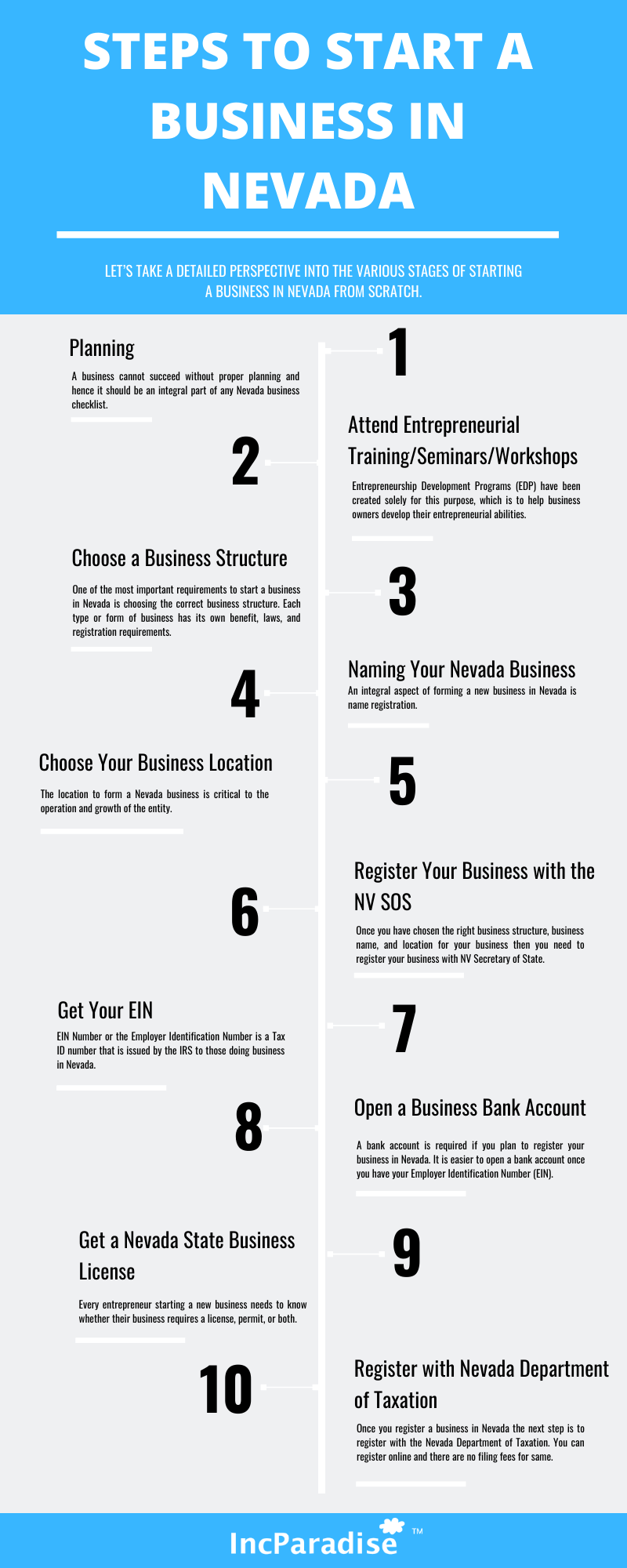
The one thought that bothers most new entrepreneurs or start-ups is identifying the steps to start a business in Nevada. There are many aspects to consider that can drive a business to grow from a sapling stage (ideas) to becoming a huge tree (revenue generation). Let’s take a detailed perspective into the various stages of starting a business from scratch.
steps to start business in Nevada

1. Planning

A business cannot succeed without proper planning and hence it should be an integral part of any Nevada business checklist. Business plans are like blueprints that provide a detail of how best to effectively operate a business based on what business objectives needs to be achieved. Some of the benefits of a strong business plan include:

  • Provide a focused road map to form a business in Nevada and target long-term growth and gains
  • Test overall viability of an entrepreneur’s objective and ideas
  • Assists with research and critical strategies focusing on complex short and long-term business issues
  • Provides an action plan related to making a business operational in the local, statewide, or global marketplace
  • Help in securing operating capital through bank loans or equity financing
  • Provide an insight into starting an online business in Nevada
  • Provide a strong business plan attracts angel investors or venture capitalists

Of course, if you are a first-time entrepreneur planning to start a business in Nevada then preparing a business plan can be quite confusing as there are so many things to consider. Some of the essential tools that you can use to create a thorough plan include:

  • Customizable Templates: A business plan will help you to decide the best business to start in Nevada. One of the ways of going about creating such a plan is to download a complete “Business Plan Template” or specific segments of the plan like “Marketing & Sales Template” or “Financial Projections Template”.
  • Innovative Apps: These are innovative applications meant for those who plan to start businesses in Nevada. The applications will help you create a “Business Model Canvas” (BMC) on your computer or laptop and can be shared with the entire team. The Business Model Canvas is basically a lean startup and strategic management template that provides a visual chart with different elements including infrastructure and finance. Some of the most popular business model canvas applications include Canvanizer 2.0, Strategyzer, etc.

The customized templates for business plans along with BMC applications make writing a business plan almost a walk in the park!

2. Entrepreneurial Training/Seminars/Workshops

Modern day entrepreneurs are considered to be the driving force of society and the economy of almost every nation and a start-up business in Nevada needs the strong leadership of an entrepreneur. Why Entrepreneurial Development Programs are Important?

The success of successful businesses in Nevada lies in strong entrepreneurship skills. A promising business owner need not only enhance their existing skills but also acquire other relevant skills and abilities to spearhead their business. Entrepreneurship Development Programs (EDP) have been created solely for this purpose, which is to help business owners develop their entrepreneurial abilities. There are times when start-up owners may possess such skills related to doing business in Nevada and EDP can help them with polishing and incubation of those skills. Some of the important aspects of EDP include:

  • Provide insight into how best to form a business in Nevada
  • How to move out of the scope of the existing market
  • How best to improve existing or new services, products, or technology
  • Create a social change
  • Create job opportunities or increase employment
  • Increase innovation opportunities by promoting research and development
  • Ensure optimum utilization of available resources to promote economic growth
  • Enhance overall standard of living

This brings us to the question of whether there are any entrepreneurial development programs available for entrepreneurs planning to register businesses in Nevada. There are training programs available and the important programs include:

  • NxLeveL for Entrepreneurs: This is a multi- week entrepreneurial development program that has been created to provide information and guidance on how you can plan for business success. Some of the aspects of setting up a business in Nevada that have been incorporated by the program include business strategies, goal-setting, management techniques, and financial accountability.
  • Economic Development Authority of Western Nevada (EDAWN): This is a program that is focused on empowering entrepreneurs through inspiration towards starting an online business in Nevada, experiential learning, connectivity as well as accolades.

Apart from the above program, some of the top colleges and universities in Nevada also offer entrepreneurship programs like UNLV Center for Entrepreneurship (CFE) and University of Nevada, Reno – Office of Enterprise & Innovation. get a quick Introduction to entrepreneurial development.

3. Attend Networking Events

If you are an entrepreneur planning to form Nevada business then networking will be critical towards determining the success of your business. A research “Informal Innovation: Entrepreneurship and Informal Communities” revealed that almost 78% of startups owe business success to networking. This is one of the most important aspects of any Nevada business checklist – every entrepreneur should attend networking events frequently.

Networking has always been the key to the overall business and revenue growth of start-ups. How do you actually network or how can you increase existing networks? The solution is as simple as attending networking events that focus on businesses in Nevada. These events are attended by successful entrepreneurs as well as future business owners. You can start by becoming a part of networking groups prior to or after you register your business name in Nevada.

Some of the ways that networking events can help you or your business are:

  • New Contacts: A networking event is a platform where you will be able to meet potential clients and also generate referrals.
  • Identify New Opportunities: One of the highlights of a networking event is that it will help you identify opportunities for future partnerships and expansion. It will also help you identify new markets for services and products if you are planning to form a business in Nevada.
  • Business Visibility: The platform will help you create high visibility for a start-up or new business. Networking events like business luncheons can raise your business and personal profile.
  • Knowledge Platform: One of the benefits that you can enjoy is sharing of ideas and receiving knowledge from other business owners or entrepreneurs. This knowledge and experience of others can assist in doing business in Nevada.

It is important to know that you can participate in any of the networking programs before and after you register your business in Nevada. You can also sign-up for such programs online and participate at a physical location. The networking programs are an important catalyst of starting an online business in Nevada. You can check out the following:

  • Small Biz NV: They provide a detailed calendar of networking and start-up business programs that you can check here. The programs have been initiated by the Department of Business and Industry, State of Nevada. This is an essential program in any Nevada business checklist.
  • Startup Weekend Events: The programs are particularly focused on Techstars Startups and they are held over weekends. The program provides a platform to connect with new customers and helps sharing experience. The program calendar is available here and it takes place in Reno or Elko.

4. Choose a Business Structure

One of the most important requirements to start a business in Nevada is choosing the correct business structure. Each type or form of business has its own benefit, laws, and registration requirements. In fact, there are separate laws and forms to register a business name in Nevada. The different types of business structures you can form in Nevada include:

  • Limited Liability Company (LLC): A Limited Liability Company is considered to be a hybrid entity, which combines the benefits of a partnership and a corporation. If you want to register a business in Nevada as an LLC then it will be governed by Chapter 86 of the 2015 Nevada Revised Statutes. You can form a domestic, foreign, and a professional Limited-Liability Company in the state. You will be required to register your business name in Nevada prior to filing formation documents.
  • Corporation: This type of business entity is considered to be created by an “artificial person” and is operated with the permission of the state of incorporation. The artificial person is only on paper and it should have at least one stockholder. If you form a business in Nevada and register it as a Corporation then it will be governed by Chapter 78 of the 2015 Nevada Revised Statutes. The type of tax treatment will help you decide the best business to start in Nevada.
  • Sole Proprietorship: A Sole Proprietorship is a type of business that any person can form and it is intended to perform a service or engage in a trade that results in profit. An entertainer, a freelance photographer, or an independent contractor are examples of a proprietorship business. It is normally a one man show. Although sole proprietorships are not required to file formation documents with the Secretary of State; you will require a State Business License to start a business in Nevada.
  • Partnership: A partnership business structure involves two or more owners and is governed by Chapter 87 of the 2015 Nevada Revised Statutes. You can register your business in Nevada in the form of different types of partnership like a Limited Partnership (LP), Limited-Liability Partnership (LLP), and Limited-Liability Limited Partnership (LLLP). You will be required to register the business name in Nevada and submit the Initial/Annual List of General Partners with the Secretary of State. Partnership businesses can be domestic or foreign entities.

Form the top Nevada Business Structures

5. Naming Your Nevada Business

An integral aspect of forming a new business in Nevada is name registration. Although many people think that they should not devote much time to choosing a business name, that should not be the case. Why? There is a process to register your business name in Nevada and as an entrepreneur, you should ensure all aspects of the naming process is considered. The following tips will help you choose the right business name:

  • You need to ensure that your chosen name is distinguishable from any other name existing on the records of the Secretary of State
  • Business names will have different criteria according to the chosen structure of business in Nevada e.g., the name of a limited-liability company must contain the words “Limited-Liability Company,” or abbreviations like L.L.C., and LLC among others.
  • The business name should provide an idea of your business activity e.g., if you plan on starting an online business in Nevada then your business name can be “Lime Kart LLC”.
  • The chosen name to form Nevada business should be easy to pronounce and should sound positive
  • The name should be available for “domain name” so that you can target your prospective customers quickly

In order to register your business in Nevada, you need to find an appropriate business name. There are several online resources that can assist you with various aspects of a business name. For instance:

  • Business Name Generators: These are software or online applications that you can use to find a suitable name. Some of the popular name generators include Novanym, Namelix, Anadea, and Wordlab among others.
  • Business Name Ideas: You can find business names based on type of product, service, or industry. One of the websites offering ideas to find an appropriate name for your business in Nevada is Squadhelp.
  • Domain Name: You can book a domain name before you register your business name in Nevada so that you are one step ahead of the competition. Some domain operators you can use include Lean Domain Search, godaddy, and hostgator among others.

Conduct a Nevada Company Name Check Now!

6. Choose Your Business Location

The location to form a Nevada business is critical to the operation and growth of the entity. In fact, the best business to start in Nevada is also dependent on the location. Fr example, those focusing on export should be located closer to a major transportation hub (Las Vegas) or a Foreign Trade Zone (Clark County). Similarly, there are several other factors to be taken into consideration like:

  • Zoning laws
  • Property Values
  • Reduced excise taxes
  • Business Insurance Rates
  • Industrial park or center
  • Minimum Wage laws
  • Opportunity zones
  • Enterprise zones
  • Government licenses and fees
  • State and Local Taxes
  • State and Local Business Incentives

If you are searching for a location to register your business in Nevada then there are sixteen counties and 1 independent city (Carson City) to choose from. The counties are:

  • Churchill County
  • Clark County
  • Douglas County
  • Elko County
  • Esmeralda County
  • Eureka County
  • Humboldt County
  • Lander County
  • Lincoln County
  • Lyon County
  • Mineral County
  • Nye County
  • Pershing County
  • Storey County
  • Washoe County
  • White Pine County

It is important to understand that you can start a business in Nevada in each of the above counties but the jurisdiction and licensing requirements will be different for each county. The Code, Ordinances, laws related to regulated businesses and administrative services will vary from one county to another.

7. Register Your Business with the NV SOS

Once you have chosen the right business structure, business name, and location for your business in Nevada, it is time to take the first step towards establishing your business. The best way to doing business in Nevada is by registering it with the Secretary of State (SOS).

Some of the important resources that will assist you to register your business in Nevada with ease include:

  • Tax: The Nevada Department of Taxation provides useful resources regarding EIN and existing tax brackets for starting an online business in Nevada.
  • Statutes and Regulations: These can help you get information and understand laws pertaining to your business structure. Click Here for Business Laws.
  • Restricted Word List: This is a resource that will help you register your business name in Nevada as usage of certain words are restricted.

Form your New Nevada Start-up with Incparadise!

8. Get Your EIN

EIN Number or the Employer Identification Number is a Tax ID number that is issued by the IRS to those doing business in Nevada. It is similar to a social security number except that it is applicable only to businesses. You can apply for an EIN only if you are planning to form a business in Nevada. You can apply for it with the IRS through mail, fax, and online. Some of the important resources that will help you with obtaining the Nevada Tax ID are:

  • Department of Taxation FAQs: This is a page focused on helping you obtain EIN to start a business in Nevada. You can download or read through their EIN guide.
  • Nevada Tax: If you are unaware of the various applicable taxes for starting an online business in Nevada then visit the Nevada Tax Center. It provides an insight into business taxes and how to manage business tax filings.

We can file EIN on your behalf!

9. Open a Business Bank Account

An important financial aspect of any business is working capital and a bank account is what keeps the capital safe. A bank account is required if you plan to register your business in Nevada. It is easier to open a bank account once you have your Employer Identification Number (EIN).

Opening a bank account has its own benefits and hence is an important part of any Nevada business checklist. Some of the benefits are:

  • It will make recordkeeping of business finances easier
  • It will help demarcate business from personal finances
  • You will be able to calculate your taxes properly and make necessary payment
  • Helps in disbursement of salary
  • Helps in tracking business expenses
  • Helps in audit prevention
  • It adds credibility to any business in Nevada

In order to learn about how you can open a bank account of your business in Nevada, read our Bank Account Opening Guide.

10. Get a Nevada State Business License

When you start a business in Nevada there are several requirements that the state requires you to fulfill and one such requirement is that of a business license. Every entrepreneur starting a new business needs to know whether their business requires a license, permit, or both. This is an integral part of your Nevada business checklist and you can apply for one along with your business formation documents. Here are some facts:

  • A business license or permit can be issued by the Secretary of State or County Clerk
  • You may require a single or multiple licenses depending on business activity or industry
  • Apart from the state business license, you may also require city or county specific licenses

In order to learn about how you can apply for a business license, check our Nevada Business License information page.

11. Register with Nevada Department of Taxation

Once you register a business in Nevada the next step is to register with the Nevada Department of Taxation. You can register online and there are no filing fees for same. This registration will help you file your returns annually. You may have to register for the following:

  • Sales tax: If you are starting an online business in Nevada that will be concentrating on selling or transferring of tangible personal property then you will be required to collect sales tax from the buyers. This tax has to be filed with the Nevada Department of Taxation.
  • Other taxes: Once you register your business in Nevada, depending on the type of business or business activity or revenue generated, you may have to file different taxes like the Commerce Tax and Modified Business Tax.

If you are unsure of how to file taxes or the type of tax you would have to file then the following resources will be useful:

Formation of a Nevada start-up has never been this easy!

How to Set Up LLC in Nevada

Date: 11/12/2019 | Category: | Author: developers

HOW TO SET UP AN LLC IN NEVADA

Nevada is considered amongst the top 10 states with good business climate, which is dependent on several factors. The fact that the state offers a competitive cost of doing business is the reason why more and more entrepreneurs are planning to set up LLCs in Nevada. Today, the economy of northern Nevada is known to be a prolific economy in the nation.

Why set up an LLC in Nevada?

In an economically strong state like Nevada, new and existing businesses will be able to enjoy growth and long-term stability. This is possible due to several factors that have a positive impact on the overall business climate as well as businesses. If you are planning to set up an LLC in Nevada then some of the factors acting as a stimulant to growth includes strong infrastructural support in the form of airports, interstate, and railroad.

A positive and strong economy is also another factor enabling people to form or register Nevada LLC. In 2018, the Real Gross Domestic Product (GDP) of Nevada was $146.22 billion as compared to $128.83 billion in 2010. The economy grew at an annual rate of 3.3% in 2018.

There are several other factors, benefits, and advantages of forming a new business in the state of Nevada.

Advantages of registering LLC in Nevada

Why would you start Nevada LLC if the state did not offer any advantages or benefits for businesses? Indeed, businesses can discover several advantages including state supported programs that have been created to ensure a business can derive maximum benefit. Some of the primary advantages include:

  • Tax Benefits: When you incorporate a Nevada LLC, your business will be able to benefit from the fact that there are almost “no state level taxes”. The state doesn’t levy any corporate income tax, personal income tax, admissions tax, unitary tax, gift tax, and franchise tax.
  • Asset Protection: A start-up or small business in Nevada has the advantage of the Significant Asset Protection Policies the state and business laws provide.
  • Incentive Programs: There are several programs implemented by the state and a business can qualify after you register Nevada LLC. These programs offer loans, grants, tax abatement, tax credits, and employee hiring incentives.

How long does it take to incorporate an LLC in Nevada?

In order to set up an LLC in Nevada, you will be required to file LLC formation documents, which are separate for domestic and foreign business entities. Once filed with the Nevada Secretary of State, the processing time for Nevada LLC or corporation can vary from 10 to 30 business days.

If time is of essence to you then you can consider expedited processing options, which will help to reduce substantially the overall time taken to incorporate a Nevada LLC. The office of the Secretary of State offers a 24-hour expedited service, 2-hour expedite service, and 1-hour expedite service but there will be an extra fee for the same.

Nevada LLC Forms and Fees for registration

If you are planning to start a Nevada LLC and are wondering whether the entire process be expensive then we have just the right plan for you!

If you are a domestic business entity then you will be required to file “Articles of Organization Form” with the Secretary of State pursuant to NV Rev Stat § 86.151 (2013). The form needs to be carefully filled as the information pertaining to your LLC will include details about owners, members, agent, and the business entity. This is where our team of experts can provide guidance and answer your queries.

If you are forming an LLC in Nevada then the cost would be as follows:

  • State fee for Articles of Organization: $75
  • State fee for a stamped copy of Articles of Organization: $30
  • Our Service Fee: $89

IncParadise LLC fee includes services like:

  • Checking name availability
  • Preparing state-approved Articles
  • Filing Articles with state
  • Sending Articles or Certificate of formation to you

Initial list & Business license

The initial list has to be submitted along with the articles of organization. Our fee is $395, which includes:

  • State Fee for Nevada LLC Initial List of Members-Managers: $150
  • State Fee for Nevada LLC Business License: $200
  • Our Processing fee: $45

Delivery of Articles

You can start Nevada LLC or make it operational once you receive the articles of organization. The articles can be delivered in the following ways:

  • USPS: Free
  • Email Shipping: Free
  • USPS Express Overnight: $30.50
  • USPS Express International: $74.25

Certificate of Good Standing

In order to start Nevada LLC, you will require a certificate of good standing also known as a certificate of existence and it is issued by the Nevada Secretary of State.

  • IncParadise fee for Certificate of Good Standing: $70
  • Fee for Expedited Certificate of Good Standing: $150

Other formation documents and services

We understand that it is never easy to incorporate an LLC in Nevada or set up a new business and hence, we are here to provide all the necessary support and services. Some of the other document filings and services offered by us include:

  • Nevada Apostille Regular: $94 (This filing takes 2-4 weeks)
  • Nevada Apostille Expedited: $294 (Filing takes 1-2 business days)
  • LLC Organizational Meeting/Company Minutes: $20
  • LLC Kit with Shipping: $98

Nevada Address and Mail Forwarding

We have several plans to choose from depending on specific business requirements. The plans are:

  • Basic Mail Forwarding Plan: $129
  • Moderate-use Mail Forwarding Plan: $180
  • High-use Mail Forwarding Plan: $280
  • Monthly Virtual Office Plan: $105
  • Monthly Virtual Office Plan with Shared Desk: $180
  • Annual Virtual Office Plan: $570

Note: Additional state payment processing fees may be included in the prices above.

Which Plan would you choose for Your LLC in Nevada?

ORDER NEVADA LLC

Forming an LLC in Nevada

Once you have taken the decision to set up an LLC in Nevada, there are certain aspects of a Limited Liability Company formation that you need to consider as well. It is a process that will take into account these aspects. Let’s look at all that is required for an LLC formation through a step-by-step approach:

1. Check Your Nevada LLC Name Availability

It is possible to incorporate a Nevada LLC or submit an application only if you have reserved a business name pursuant to NV Rev Stat § 86.171 and § 86.176 (2013). It is important to ensure that the desired business name is available and should be distinguishable from any other name on file with the Secretary of State. Conduct a business name availability check right now!

2. Choose Your Nevada LLC Registered Agent

In order to start Nevada LLC, a business is required to designate and maintain a Nevada Registered Agent like IncParadise pursuant to NV Rev Stat § 86.231 and § 86.241 (2013). There are two options to choose from:

  • Hire a new agent for LLC Nevada
  • Change of Nevada registered agent

In order to designate a Registered Agent, you will have to file the “New Company Order Form” if it is a start-up business and the “Change Order Form” if the business is changing their agent.

Note: You will be required to file the Registered Agent Acceptance/Statement of Change form along with the Articles of Organization

3. Create and File Your Article of Organization

One of the primary steps to register a Nevada LLC is by creating and filing Articles of Organization pursuant to NV Rev Stat § 86.151 (2013). The articles have to be filed with the Secretary of State along with the required filing fees. The articles contains important information including name of the limited liability company, name and address of managers or members, registered agent information, and powers enumerated in NV Rev Stat § 86.161 (2013).

4. Nevada LLC Operating Agreement

It is always recommended to set up an LLC in Nevada by creating and filing an Operating Agreement. It is important to note that an operating agreement can only be adopted if there is unanimous vote or un-unanimous written consent of the members as stated in NV Rev Stat § 86.286 (2013). This agreement provides the rights and powers of an LLC and its owner, members, or managers.

Confused about how to create an LLC Operating Agreement? Let the experts take care of your business requirements.

5. Your Nevada LLC Tax Requirements

Yes, Nevada doesn’t have any state business taxes and since you are planning to incorporate Nevada LLC, it will be a pass-through tax entity. This simply means that the burden of paying federal income taxes will shift from the LLC to the individual members. Does a Limited Liability Company pay any taxes in Nevada?

  • An LLC will be required to pay employer taxes, if it has employees. It will be paid to the IRS and you will have to obtain a federal employer identification number (EIN) to facilitate the payment of taxes.
  • If you start Nevada LLC that is focusing on selling goods in the state then you will be required to collect as well as pay sales tax. You will have to register with the Department of Taxation for same.
  • You may have to file Commerce Tax return with the Nevada Department of Taxation if the gross revenue exceeds $4,000,000 during the taxable year.

6. Get Your Nevada LLC Business License

While planning to register Nevada LLC, it is important to also focus on getting your business license. The type of license required is dependent on the type of business and the licenses issued by the state including General Licenses, Privileged Licenses, and Regulated Licenses. Apart from this, licenses are also issued by Nevada counties. It is important to note that if your business is operating from multiple jurisdictions within a specific county then you may be required to obtain a city business license from each of the jurisdictions. You can apply for business license along with the articles of organization.

7. File Your Annual Report

In the process to set up an LLC in Nevada, one of the important documents that has to be filed is the Annual List also known as the Annual Report. It contains information pertaining to the limited-liability company and is governed by Nevada Revised Statutes § 86.263. This annual list has to be filed with the Secretary of State by the end of the LLC registration anniversary month.

Note: If a Limited Liability Company fails to file the Annual Report or List then the Secretary of State may deem the LLC to be in default pursuant to Nevada Revised Statutes § 116.31155 or 116B.620.

How IncParadise helps you to start an LLC in Nevada?

You can form a small start-up, incorporate it as an LLC in Nevada, register a foreign entity or convert your existing business in another state to a Nevada entity. All this is possible with proper guidance and assistance provided by IncParadise towards filing relevant forms with the Secretary of State and Department of Taxation.

We at IncParadise are one of the respected registered agents in Nevada and have been responsible for providing the necessary support required to start Nevada LLC in the quickest possible time and without any hassles. IncParadise will help you with LLC formation by:

  • Helping you choose a business name pursuant to NV Rev Stat § 86.171 (2013)
  • Providing assistance in reserving business name for 90 days
  • Providing information related to required and optional provisions and information for filing of Articles of organization pursuant to NV Rev Stat § 86.161 (2013)
  • Ensuring all filing requirements as specified by NV Rev Stat § 86.151 (2013) are met in order to register Nevada LLC
  • Aiding in filing and processing of all applications including Registered Agent Order Form and Operating Agreement
  • Providing information pertaining to taxes to be paid in the state and if required, assist with filing application for tax identification number.
  • Helping you to identify the type of business and ensure you obtain the correct business license.

One of the greatest benefits IncParadise provides to businesses planning to register in the state is access to the Entity Management Software. In order to set up an LLC in Nevada successfully, you will be required to file different documents and ensure all your certificates and documents are accessible. This is exactly what the Entity Management Software will help you to do. It will:

  • Help you to stay updated with the operations of your company
  • Aid with renewal of any services like business license online using the Client Zone
  • Ensure you are able to check and verify the status of your existing orders
  • Provide important alerts and notifications related to business requirements like annual list filing
  • Provide access to a secure mail forwarding service

ARE YOU READY TO REGISTER NEVADA LLC?

Nevada LLC Law

Date: | Category: | Author: developers

NEVADA LLC LAW

Nevada is one of the few states that provide a business friendly climate and a strong Nevada LLC law that intends to protect a business enterprise and provide valuable information regarding its formation and operation in the state.

An Introduction – Nevada LLC Act

The current Nevada LLC Act is known as the 2013 Nevada Revised Statutes, Chapter 86 – Limited-Liability Companies. Some of the most important laws related to the functioning and existence of a Limited Liability Company were first defined in the Nevada statutes between 1991 and 2001. The Chapter 86 – Limited-Liability Companies were added to Nevada Revised Statutes in 2005.

What does the Nevada LLC Law comprise of? It provides important information pertaining to operations, filing requirements, fees, agents, provisions, business name, registered agent, organizational existence, general powers, operating agreement, management, capital, profit, liability, and dissolution among others.

The primary objective of the Nevada LLC Act is to help businesses to legally operate in the state. The NRS86 of the Nevada Revised Statutes are considered to be pro-business and thus enables a business friendly legal as well as a tax environment. If you are planning to establish your business in Nevada then you will be required to file necessary formation or registration paperwork and meet requirements as specified by the Nevada Limited-Liability Companies Act.

Nevada LLC Name Requirement

The Nevada LLC name requirement is an important aspect of business formation in the state and is governed by Chapter 86 of the Nevada LLC Act. Naming requirements for a business entity can be categorized under two subsections and they are:

  • Naming Guidelines
  • Name Availability Check

Naming Guidelines

A business name is integral to any organization and is one of the most important aspects of forming an LLC in Nevada. There are certain naming requirements governed by the Nevada LLC Law that businesses will have to comply with. Let us look at the key naming guidelines as set forth in the 2013 Nevada Revised Statutes.

  • The name of your business entity must contain phrases like Limited-Liability Company, Limited Liability Company, Limited Company or Limited. The name may also contain abbreviations like L.L.C., Ltd., LLC or LC. The word “company” can also be abbreviated as Co. This is governed by Nevada LLC Act – NV Rev Stat § 86.171 (2013).
  • The proposed name of your business entity should be distinguishable from any other name on the records maintained by the Secretary of State.
  • The business name should not contain words or phrases that could be confused with government agencies like state departments, treasury, department of taxation etc.
  • The Nevada LLC Law, Title 7 of the Nevada Revised Statutes, advocates that the usage of certain words in a business entity name may be restricted.

Note: If you are planning to form a professional limited liability company then the naming guidelines according to Nevada LLC Act must contain specific words and phrases. The name should contain words like Professional Limited Liability Company or abbreviations like “Prof. L.L.C.,” “P.L.L.C.,” or “PLLC”.

Name Availability Check

Once you have identified a business name that is compliant with all requirements of the Chapter 86 – Nevada LLC Act, the next step is to check if the chosen name is available so that you can reserve it with the Secretary of State.

You can use the state portal for Nevada Business Search to check the availability of your chosen business name. In order to accomplish an effective search, you will have to type the business name without any identifiers like L.L.C or LLC as mentioned in Nevada LLC Law. This search will return names that are either the same as chosen by you or similar. Let’s look at an example:

  • If you search the name “Ibiscus” and choose the option “Name Starts With” then it will show the result as -“No records found with your search criteria.”
  • If you search the name “Ibiscus” and choose the option “Name Contains” then it will show the result as – “Your Search Criteria returns 300 results”. It will show information like Name of the business entity, its status, filing date, type of entity, business ID and entity number.

It is highly recommended to conduct a detailed search using all possible parameters prior to applying for name reservation.

Articles of Organization Requirements

You can form any type of business in the state of Nevada but if you are planning to start a Limited Liability Company then Chapter 86 of the 2013 Nevada LLC Act requires a business to file specific documents related to the formation. The most important document for new business registration in Nevada is Articles of Organization, which has to be filed with the Secretary of State along with the required fee.

There are certain provisions that have been set forth by NV Rev Stat § 86.161 (2013). This chapter of the Nevada LLC Law requires a business entity to provide specific information regarding the organization. The Articles of Organization should contain the following:

  • Name of the limited-liability company
  • Name and address of the registered agent of LLC to enable service of process
  • Name and address of the owners, members or managers of LLC
  • Statement providing information of the company being managed by one or more owners, managers, and members.
  • Statement providing information setting forth the relative rights, duties, and powers of the series

You can file the Articles of Organization through mail, by hand, and online.

Form your LLC hassle Free with Our LLC formation Services!

ORDER NEVADA LLC

Nevada LLC Members Information Requirements

There are several advantages of forming an LLC as the Nevada LLC Act does not require it to follow the same rigorous operational requirements as is the case of a corporation. At the same time, an LLC can have a single owner or multiple owners often known as members. One of the salient aspects of a Nevada LLC is that the state does not require owners or members to residents of the state.

The Nevada LLC Law also allows a Limited Liability Company to employ non-economic members. Such members will not own any portion of the LLC but will still have voting rights of economic members. There are specific Nevada requirements for LLC members governed by NV Rev Stat § 86.291 – § 86.326 (2013) that need to be met and these are:

  • Nevada LLC Act states that a Nevada Limited Liability Company should have at least one member or manager
  • All members of LLC should be 18 years of age or older
  • An LLC in Nevada will have to provide a list of LLC members within 30 days after it has been formed or registered. This list is also known as the Initial List
  • Nevada LLC Law requires names and addresses of members to be listed in the Articles of Organization
  • The members and their rights, powers, and duties need to be mentioned in the operating agreement.

Asset Protection for Nevada LLC

One of the salient benefits of forming an LLC in Nevada is their “Asset Protection law”. The Nevada LLC Act does not require businesses to list company assets hence a member will not be responsible for any liabilities of the LLC.

In the state of Nevada, a business will enjoy favourable laws related to asset protection and will be able to create an asset protection trust. Since this protection trust is under the purview of Nevada LLC law and Nevada asset protection statutes; it will protect members or the LLC assets from creditors seeking to pursue a legal case.

The Nevada asset protection trust provides protection to a wide variety of assets including personal property, family heirlooms, real estate, bonds, stocks, and cash among other assets. There is another asset protection option and it is known as the “charging order”. The strong and pro-business Nevada LLC Act provides the opportunity to single-owner and multi-owner LLC’s to use the charging order for protecting assets.

LLC Registration Services in Nevada
is just a Click Away!

Nevada LLC – Business License

Date: | Category: | Author: developers

NEVADA LLC – BUSINESS LICENSE

An integral part of the process of forming a Limited Liability Company is applying for a Nevada business license. A new business whether it is into manufacturing, services, retail, or scientific innovation, the businesses can become operational only if they have the required permit or license.

Introduction – Business License for Nevada LLC

Nevada is one of the top states when it comes to providing a pro-business environment to start-ups. The state and local government have committed themselves to ensure Nevada businesses enjoy a low-regulation environment and this includes low cost start-up, and streamlined Nevada LLC business license process.

A business license is a document that confirms that a business can operate in a specific jurisdiction in Nevada or anywhere within the state. The license is a type of permission issued to a business depending on the type of business or industry. The licensing process is different for different states and there are specific organizations that do not require a Nevada business license. They are:

  • Government entities
  • Non-profit religious entities
  • Charitable organizations
  • Fraternal organizations

Apart from organizations as mentioned above, certain manufacturers will not be required to obtain a Nevada business license pursuant to NV Rev Stat § 76.103 (2017).

Do I need business licenses and permits for my Nevada LLC?

If your business doesn’t belong to any of the above category, will it require a business license? Yes. In Nevada, all Title 7 entities need to obtain a business license. A title 7 entity is any business entity that has been organized under the Nevada Revised Statutes and has filed formation or incorporation documents with the Secretary of State. Title 7 entities include domestic and foreign limited liability companies (LLC), limited partnerships (LP), corporations, limited liability partnerships (LLP), limited liability limited partnerships (LLLP) and business trusts. Nevada business license is governed by Chapter 76 of the 2015 Nevada Revised Statutes.

It is important to also understand that the business license or permit required is dependent on the type of business. The location of your LLC will also play an important role in defining the licensing needs.

Since a Nevada LLC business license is mandatory for most businesses, failure to comply with the licensing or permit requirements can lead to a penalty of $100 and payment of additional fees pursuant to NV Rev Stat § 76.110 (2017). Such an LLC can even be subjected to operational restrictions. The penalties for operating without a business license can vary from $1,000 to $10,000.

Types of Business License in Nevada

Most businesses registering in the state of Nevada will require a license or a permit. The Nevada LLC business license can be defined under the following categories:

State Business License (SBL)

This is a mandatory license for most start-ups and is issued by the Nevada Secretary of State (SOS). It has to be renewed annually. The Secretary of State has set certain requirements for state business license and it is governed by NRS 76.100. It states that if a business entity is required to file an initial list or annual list with the Secretary of State then it must obtain a state business license during the time of filing the list.

Federal License

There are only specific businesses that may require a Federal License or permit. The requirement of this type of Nevada LLC business license is dependent on the type of activity a business in involved in and accordingly contacts the agency responsible for issuance of such a license. Some of the business activities and their corresponding issuance agencies include:

  • Drug Manufacturing: This license is issued by the Food and Drug Administration (FDA)
  • Ground transportation: This license is issued by the Department of Transportation (DOT)
  • Investment Advising: This federal license is issued by the Securities and Exchange Commission (SEC)
  • Preparation of meat products: This federal license is issued by the Food and Drug Administration (FDA)
  • Selling alcohol, tobacco or firearms: This Nevada LLC business license is issued by the Bureau of Alcohol, Tobacco, Firearms, and Explosives (AFT)
  • Broadcasting: This license is issued by the Federal Communications Commission (FCC)

Retail sales permit

This permit is issued by the State Department of Taxation. You will need to check with the taxation department to identify if your business requires this permit.

Local license

If you are forming a small business LLC in Nevada then you may require just a local license, which will enable your start-up to operate within the county or city where it is situated. Such licenses are issued by the county clerk office or city administration.

Note: If you are planning to operate in multiple cities or counties then you will be required to apply for a local Nevada business license in each of the counties or cities.

Special Permits

This is applicable to small businesses in cities or counties and depending on the type of business, special permits can include those issued by the Fire, Police, Health, or Building Departments.

There are other processes and requirements that need to be met in order to get your Nevada LLC business license. Let’s look at an example:

If you are planning to start a “child care” facility then prior to issuance of the Nevada LLC business license, the concerned authorities (Department of Health and Human Services Nevada Division of Public and Behavioral Health) will conduct an inspection. The inspection is there to ensure you or your facility fulfils necessary business license requirements, safety regulations, insurance and zoning requirements of the city or county it is located in.

IncParadise can guide you through the process of obtaining a Nevada business license!

RESOURCES ON BUSINESS LICENSE

Nevada Business License Application Fee

The Nevada LLC business license fee is subject to the type of license your business entity requires in the state. The fee will be different for federal, state, and city or county licenses.

IncParadise can help you obtain the state business license. We can also provide assistance with information concerning local business licenses and their applicable fees.

If I’m going to start a single-member LLC, do I need a business license?

Yes, a Nevada single member LLC (SMLLC) is a business entity that are required by NV Rev Stat § 76.100 (2017) to file an annual list with the Secretary of State and hence will have to obtain a Nevada LLC business license to conduct business in the state. The business license application is included in the Annual List of Members or Managers of a Limited Liability Company.

How IncParadise can help you with Nevada Business License?

There are different types of Nevada business license that is issued on the basis of the activities conducted and the location of a business. Your business may require:

  • A state business license (SBL)
  • A State and Federal License
  • A State and Local County License

It may look like a complicated process especially when it comes to identifying what type of license your company should ideally apply for. This is where our experience and expertise will assist you with ensuring you are able to apply for and obtain the correct Nevada LLC business license.

We help make new business filing
and submissions faster and easier!